BRIAN KLEPPER
First published in Employee Benefit News, April 5, 2010
The article "Reconfiguring onsite health clinics" (EBN February) presented a remarkably limited perspective on modern clinics, resulting in statements like this one: "'In a tough economy, an initial clinic approach should probably employ mid-level practitioners, such as a nurse practitioner or a physician assistant, because they are most cost-effective when rendering basic medical services,' explains Mercer's [Bruce] Hochstadt."
Monday, April 5, 2010


Friday, April 2, 2010
Value Trumps Price In Onsite Clinics
BRIAN KLEPPER
First published in American City Business Journals (in Boston, Silicon Valley, Jacksonville, Nashville, San Jose and elsewhere.)
Onsite health clinics are new territory for most employers. It can be difficult to sort through the different approaches used by different vendors. Worse, in difficult economic times it’s tempting to “get in” as cheaply as possible.But like many purchases, you may get what you pay for with clinics, especially if you scrimp. Here are three reasons to favor value over price when considering an onsite clinic vendor:
First published in American City Business Journals (in Boston, Silicon Valley, Jacksonville, Nashville, San Jose and elsewhere.)
Onsite health clinics are new territory for most employers. It can be difficult to sort through the different approaches used by different vendors. Worse, in difficult economic times it’s tempting to “get in” as cheaply as possible.But like many purchases, you may get what you pay for with clinics, especially if you scrimp. Here are three reasons to favor value over price when considering an onsite clinic vendor:
Monday, March 22, 2010
On Really Managing Care and Cost
BRIAN KLEPPER
One of my favorite health care stories is about Jerry Reeves MD, who in 2004 took the helm of a 300,000 life health plan in Las Vegas, including about 110,000 union members, and drove so much waste out of that system - without reducing benefits and while improving quality - that the union gave members a 60 cent/hour raise. There was no magic here. It was a straightforward and rigorously managed combination of proven approaches.
Dr. Reeves' work betrayed the lie that tremendous health care costs are inevitable. To a large degree, the nation's major health plans abetted this perception when they effectively stopped doing medical management in 1999. (Most have recently begun managing again in earnest.) The result was an explosion in cost - 4 times general inflation and 3.5 times workers earnings between 1999 and 2009 - that has priced a growing percentage of individual and corporate purchasers out of the health coverage market, dangerously destabilizing the health care marketplace and the larger US economy. In 2008, PriceWaterhouse Coopers published a scathing analysis suggesting that $1.2 trillion (55%) of the $2.2 trillion health care spend at that time was waste.
One of my favorite health care stories is about Jerry Reeves MD, who in 2004 took the helm of a 300,000 life health plan in Las Vegas, including about 110,000 union members, and drove so much waste out of that system - without reducing benefits and while improving quality - that the union gave members a 60 cent/hour raise. There was no magic here. It was a straightforward and rigorously managed combination of proven approaches.
Dr. Reeves' work betrayed the lie that tremendous health care costs are inevitable. To a large degree, the nation's major health plans abetted this perception when they effectively stopped doing medical management in 1999. (Most have recently begun managing again in earnest.) The result was an explosion in cost - 4 times general inflation and 3.5 times workers earnings between 1999 and 2009 - that has priced a growing percentage of individual and corporate purchasers out of the health coverage market, dangerously destabilizing the health care marketplace and the larger US economy. In 2008, PriceWaterhouse Coopers published a scathing analysis suggesting that $1.2 trillion (55%) of the $2.2 trillion health care spend at that time was waste.
Saturday, March 20, 2010
Vote Yes
BRIAN KLEPPER and DAVID C. KIBBE
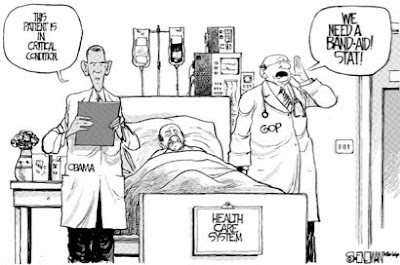
One of us was at a local diner yesterday, when a good friend and health plan broker walked up to say hello. This guy delivers premium increases every day to employers, and understands how broken things are. "I hope Congress votes yes," he said flatly. "We've got to finally move beyond the status quo and try to change the system."

One of us was at a local diner yesterday, when a good friend and health plan broker walked up to say hello. This guy delivers premium increases every day to employers, and understands how broken things are. "I hope Congress votes yes," he said flatly. "We've got to finally move beyond the status quo and try to change the system."
Sunday, March 14, 2010
The Surprise
BRIAN KLEPPER
Check out this March 3rd article - see the image - from the recent HIMSS conference, in which Dave Garets, President and CEO of HIMSS Analytics, "gazes into the future and predicts major trends for the next 12 months." HIMSS Analytics is the research and consulting arm of the health IT vendors' association, and presumably on Health IT's leading edge.
From the article:
"Q: What will constitute the surprise of 2010 - the one technology or policy or X-factor that no one saw coming."
Check out this March 3rd article - see the image - from the recent HIMSS conference, in which Dave Garets, President and CEO of HIMSS Analytics, "gazes into the future and predicts major trends for the next 12 months." HIMSS Analytics is the research and consulting arm of the health IT vendors' association, and presumably on Health IT's leading edge.
From the article:
"Q: What will constitute the surprise of 2010 - the one technology or policy or X-factor that no one saw coming."
Monday, March 8, 2010
Why Rush Vendor Certification of EHR Technologies
DAVID C. KIBBE and BRIAN KLEPPER
A surprise move by ONC/HHS indicates the wheels may be falling off health IT reform at about the same rate they've fallen off Democrats' broader health reforms.
David Blumenthal and his staff have unveiled two separate plans to test and certify EHR technology products and services. We don't think this is a good idea. We've supported the purpose and spirit of the ARRA/HITECH incentive programs, and believe ONC's/HHS' re-definition of EHR technology puts it on a trajectory to improve the quality and efficiency of health care in the U.S. But this recently-announced two-stage EHR technology certification plan bears all the marks of a hastily drawn up blueprint that, if rushed into production, could easily collapse of its own bureaucratic weight.
A surprise move by ONC/HHS indicates the wheels may be falling off health IT reform at about the same rate they've fallen off Democrats' broader health reforms.
David Blumenthal and his staff have unveiled two separate plans to test and certify EHR technology products and services. We don't think this is a good idea. We've supported the purpose and spirit of the ARRA/HITECH incentive programs, and believe ONC's/HHS' re-definition of EHR technology puts it on a trajectory to improve the quality and efficiency of health care in the U.S. But this recently-announced two-stage EHR technology certification plan bears all the marks of a hastily drawn up blueprint that, if rushed into production, could easily collapse of its own bureaucratic weight.
Monday, March 1, 2010
After the Failure of Reform
BRIAN KLEPPER AND DAVID C. KIBBE
 The stalemate in the bi-partisan health care summit was cast the moment it was announced.
Republicans demanded that the reform process start anew, and Mr. Obama insisted on the Senate bill as the framework going forward. The President may now offer a more modest reform bill that can demonstrate some progress on the health care crisis, but that remains to be seen. We hoped the White House would seize the opportunity presented by Massachusetts’ election of Scott Brown to begin again, huddling away from the lobbyists to develop a new set of provisions that would include reasonable Republican elements, like medical liability reform, as well as other meaningful cost reduction provisions excluded from the first round of bills: pricing/quality transparency, a move away from fee-for-service reimbursement, and the re-empowerment of primary care.

Republicans demanded that the reform process start anew, and Mr. Obama insisted on the Senate bill as the framework going forward. The President may now offer a more modest reform bill that can demonstrate some progress on the health care crisis, but that remains to be seen. We hoped the White House would seize the opportunity presented by Massachusetts’ election of Scott Brown to begin again, huddling away from the lobbyists to develop a new set of provisions that would include reasonable Republican elements, like medical liability reform, as well as other meaningful cost reduction provisions excluded from the first round of bills: pricing/quality transparency, a move away from fee-for-service reimbursement, and the re-empowerment of primary care.
Subscribe to:
Posts (Atom)